
Why UGC ads perform better than brand-produced creative
UGC ads (user-generated content used in paid media placements) consistently outperform polished brand creative on the metrics that matter most: click-through rate, cost-per-click, and conversion rate. The reason is structural. A creator holding a product in a phone-filmed vertical video looks like every other piece of organic content in the feed. A high-production brand spot does not. That mismatch triggers scroll behavior, and once a user scrolls, you have lost them.
The performance gap shows up in hard numbers. 94% of shoppers visit a retailer after seeing creator content, according to research cited across the influencer marketing industry. That attribution path runs directly through trust. When someone who looks like your customer talks about your product, the message carries social proof that a brand announcement cannot replicate.
Lower scroll friction also translates to lower CPMs. Platforms reward content that earns engagement, and UGC ads typically generate higher engagement rates than studio-produced equivalents, which brings down your cost to reach a given audience. More impressions, lower spend, stronger conversion signals.
One distinction worth making clearly: this article covers paid UGC, meaning licensed creator content deployed through your brand's ad account, not organic posts that happen to feature your product. If you want the full picture on what UGC actually is and how it differs from influencer content, start with what UGC actually is before coming back here.
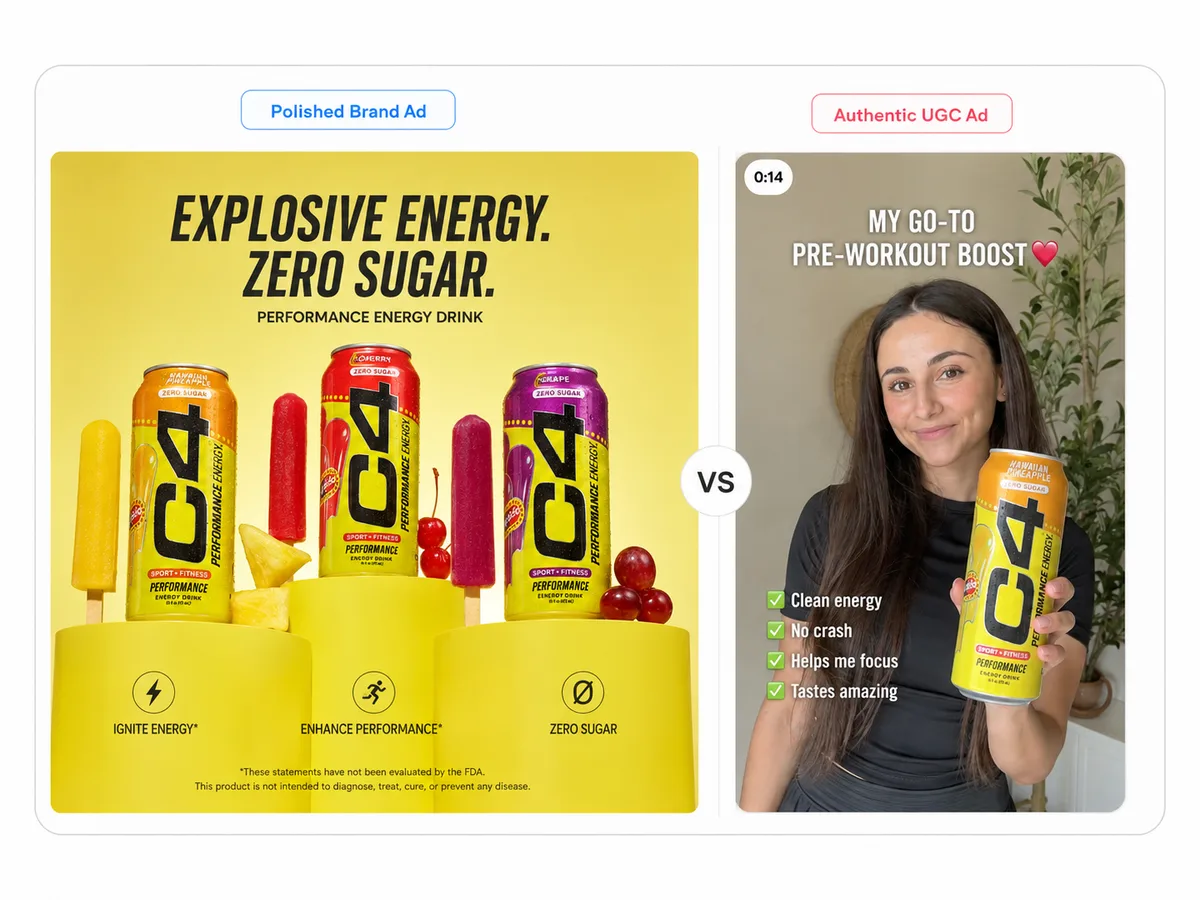
Polished brand ads versus authentic UGC: How real creator endorsements often resonate more authentically with audiences than traditional corporate marketing campaigns.
The 4 main formats for UGC ads (with examples)
Not all UGC ad formats work the same way, and choosing the right one depends on your placement, audience, and objective.
UGC video ads are the highest-performing format on most paid social channels right now. Talking-head clips, unboxing videos, and product walkthroughs all work well as TikTok Spark Ads, Instagram Reels placements, and in-feed pre-roll. The key is that they feel filmed by someone, not produced for someone.
Static UGC photo ads still deliver strong results on Facebook and Instagram, particularly in carousel format. A creator photographing your product in a real environment, styled naturally rather than against a studio background, carries the same authenticity signals as video at a fraction of the production cost. Single-image placements using UGC photography regularly outperform art-directed brand imagery on CPM and CTR benchmarks.
Review-style UGC ads use a screenshot or quote format to surface real creator opinions as ad creative. These are common in DTC health, beauty, and apparel verticals where social proof is a direct purchase driver. A screenshot of a creator's caption or a pulled quote overlaid on product imagery converts because it reads as testimony, not advertising.
Story and short-form UGC (vertical clips of 15 to 30 seconds) are purpose-built for volume testing. Production is fast, creator fees are typically lower, and you can run 10 variants in the time it would take to produce one brand video. Groupon used this kind of volume-driven approach to generate 1,192 pieces of UGC content across a campaign, achieving 8.6% average engagement and a 7% CVR lift over control creative.
Real UGC content examples: what good looks like
Three brand case studies illustrate what separates high-performing UGC ads from content that simply fills a placement.
Charlotte Tilbury built a creator-led beauty content strategy that leaned into tutorial and review formats from creators whose audiences aligned closely with their customer profile. The brand deployed this content across paid social placements, iterating on the formats that drove the strongest early engagement signals. The result: a 341% ROI on paid UGC creative. The pattern here is creator-audience fit. Charlotte Tilbury did not simply put any creator in front of their products. They matched creators to specific product lines and audience segments, then let the content perform naturally within paid placements.
Fender took a gear-demo approach, sourcing creator content that showed real musicians using their instruments in authentic playing contexts. These clips ran as paid placements targeted to musicians and gear enthusiasts, audiences who are sophisticated enough to ignore anything that reads as manufactured endorsement. The native format of creator-shot gear content resonated precisely because it looked like the organic content that audience already consumes. Fender achieved 5X ROAS on paid UGC creative, a result that reflects both strong creative selection and precise audience targeting.
Groupon's approach focused on volume rather than individual creator profile. By generating 1,192 pieces of UGC and rotating creative aggressively, they avoided ad fatigue while continuously feeding their testing framework with fresh variants. The 7% CVR lift came from the cumulative effect of persistent, authentic social proof across placements. The pattern: when no single creator carries outsized authority in your category, volume and variety drive results more reliably than any single piece of content.
Across all three, the common thread is that the creative worked because it was matched to context: the right format for the platform, the right creator for the audience, and a clear conversion path at the end of each piece.
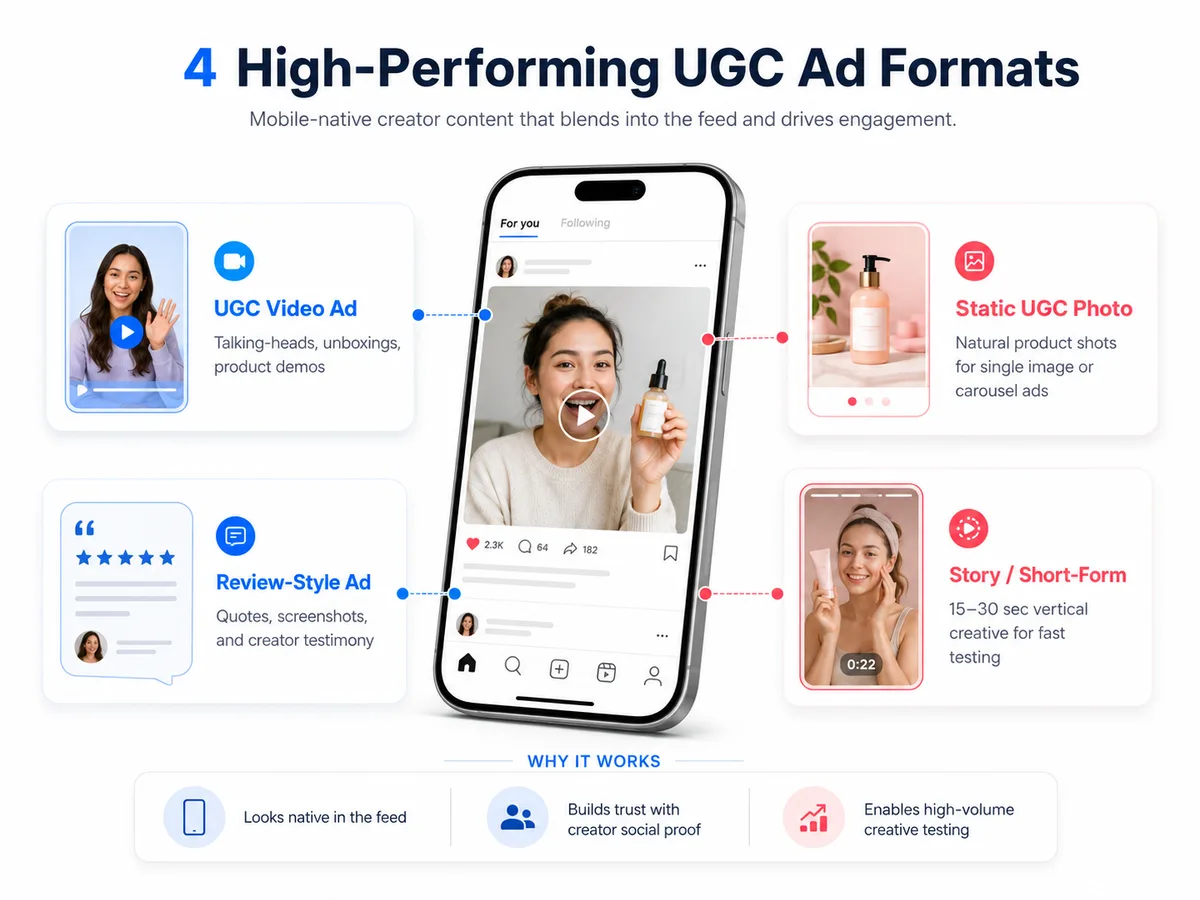
Four high-performing UGC ad formats that blend authentically into social feeds while driving engagement through creator social proof and native content styles.
How to brief creators for paid-ready UGC
A brief for paid UGC is not the same as a brief for organic influencer content. The structure needs to account for ad mechanics, not just brand guidelines.
The frame that works: hook in the first 3 seconds, product demo or use-case in the middle, and a clear CTA at the end. The hook determines whether the content stops the scroll. The middle section builds the case. The CTA tells the viewer what to do. That three-part structure applies across formats, whether you are briefing a 15-second Story clip or a 60-second in-feed video.
What you should not over-brief: every line of dialogue, every transition, every reaction. Scripted UGC reads as scripted, and the authenticity signal disappears immediately. Give creators the product context, the key benefit to communicate, and the CTA, then let them film it in their own voice.
Technical specs are non-negotiable, though. Aspect ratios (9:16 for vertical, 1:1 for feed), safe zones for text overlays, minimum resolution, and maximum file size all affect whether content can run without platform rejection or quality degradation. Include these in every brief.
Licensing is the detail most brands miss until it becomes a problem. Confirm paid social usage rights, including the specific platforms, placement types, and duration of use, before production starts. Retroactively negotiating rights after content has been filmed and approved is expensive and slow. Creator.co handles usage rights at the platform level through automated licensing workflows built into the brief and approval process, which removes the most common source of post-production friction.
See if our AI finds the right creators for your brand
London searches 175K+ vetted creators and builds your shortlist in under 3 minutes. No account, no credit card.
Testing and scaling UGC ad creative
The testing framework that produces reliable results: run 5 to 10 UGC creative variants simultaneously against a single control asset (typically your current best-performing brand creative). Each variant should isolate one variable so you can read causality, not just correlation.
Variables worth testing: hook style (question vs. statement vs. demonstration), creator persona (age, aesthetic, use case), product angle (benefit-led vs. problem-solution vs. lifestyle), and CTA copy (shop now vs. try it vs. get yours). Do not change multiple variables in a single test or your data becomes unreadable.
Read results at 48 hours using CTR and hook rate (the percentage of viewers who watch past the first 3 seconds). These two metrics signal creative quality before you have spent enough to generate statistically meaningful conversion data. If a variant is winning on hook rate but not CTR, your opening is working but your middle section is not closing. If CTR is strong but conversions lag, the issue is likely post-click, not the creative itself.
Once a winning variant emerges, scale spend incrementally rather than immediately. Aggressive budget increases can reset platform learning phases and distort the performance data you used to identify the winner in the first place. Charlotte Tilbury's 341% ROI was not a single campaign result. It came from iterating on winning creator formats over time, using each round of testing to sharpen the next brief.
Building a sustainable UGC ad pipeline
A single UGC campaign is a missed opportunity. Every brief you post, every creator you approve, and every piece of content you license should be treated as an addition to a long-term creative library.
Volume is what makes paid UGC sustainable at scale. 200 licensed UGC assets cost 60 to 80% less than equivalent studio production, and they have longer shelf lives because they do not carry the visual signals that date brand creative (set design trends, stock music styles, production aesthetics). A creator filming in their apartment looks the same in six months as it does today.
Ad fatigue on paid social is real and accelerating. Most brands running paid social at meaningful spend levels need fresh UGC creative every 4 to 6 weeks to maintain CTR and prevent frequency-driven CPM increases. That cadence requires a pipeline, not a campaign approach.
The Creator.co workflow covers the full cycle: brief posting, creator applications, content review, approval, and licensing, all managed in one platform. For brand marketing teams running multiple campaigns across channels, the automation component matters practically. Brands using Creator.co save 15 to 20 hours per campaign by removing the manual coordination that typically happens across email, Dropbox, and contract management tools. Creator.co is a G2 Leader for Spring 2026, reflecting both platform maturity and user satisfaction across brand and agency customers.
Building that pipeline is the same work as building a scalable influencer program. If you are starting from scratch or want to pressure-test your current approach, how to build an influencer program that scales covers the strategic foundation in full.