
How to run a Black Friday creator marketing strategy
Black Friday does not reward last-minute decisions. CPMs spike in November, ad inventory tightens, and every brand in your category floods social feeds with the same discount message. The brands that win the Holiday Season are already briefing creators in September. This guide gives you the exact timeline, sourcing logic, seeding approach, and measurement framework to build a Black Friday marketing strategy around creators, before the window closes.

Modern shopping mall with festive holiday décor - a prime location for retail and fashion influencer content creation
Why Black Friday rewards brands that start their creator campaign early
Creator content takes time to work. A creator needs to receive your product, use it authentically, film it, edit it, post it, and let the algorithm build organic reach before your sale goes live. That cycle runs 4 to 6 weeks on average. Brands that brief creators in late October are asking for content that posts into a cold audience during the most competitive week of the year.
The other problem is trust. Black Friday shoppers see hundreds of polished promotional ads. They scroll past most of them. Authentic creator content, where a real person explains why they actually like a product, converts during this period precisely because it does not look like an ad.
Creator.co has run more than 10,000 brand campaigns across 9-plus years since founding in 2016. Seasonal campaigns consistently show the same pattern: brands that start early generate more content volume, better organic reach, and stronger ROAS when the sale window opens. The brands that wait scramble, settle for under-prepared creators, and measure disappointing results.
This article covers the full system: your countdown timeline, how to source the right creators, how product seeding builds content ahead of the sale, how to structure the campaign for conversion, and what to measure when it is over.
Your Black Friday timeline, working backwards from the sale
The single most useful thing you can do right now is open a calendar and count back from Black Friday. Here is the framework Creator.co recommends for a seasonal creator campaign.
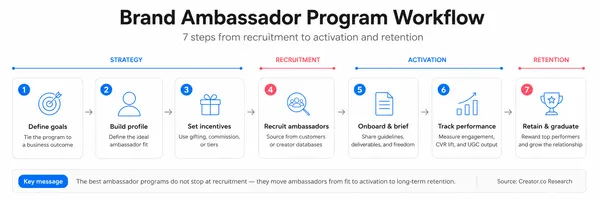
The complete brand ambassador program workflow spans seven strategic steps, from initial strategy and recruitment through activation and long-term retention to maximize influencer partnership ROI.
Weeks out | Priority action |
|---|---|
8–10 weeks | Finalize your Holiday offer, define creator brief, begin sourcing |
6 weeks | Ship seeding product to confirmed creators |
4 weeks | Creators produce content, tease early posts go live |
2 weeks | Warm-up content live across creator channels |
Sale week | Conversion-focused posts with codes and affiliate links |
Cyber Monday | Extend best-performing content, retarget engaged audiences |
Physical product seeding has the longest lead time of any step. You need to pick, pack, and ship product. Creators need time to receive it, actually use it, and form a genuine opinion. Skipping or compressing this step produces scripted-feeling content that audiences can detect immediately.
For brands running owned content alongside creator campaigns, the same lead-time logic applies. Publish landing pages and organic blog content early so search engines index them before the traffic spike. Influencer marketing strategy articles have documented how much organic traction matters during competitive seasonal windows. Creator.co runs date-anchored seasonal campaigns year-round, including Father's Day and back-to-school activations, with brands that treat the calendar as a campaign asset rather than a deadline.
Sourcing the right creators for a seasonal push
Not every creator on your list belongs in a Black Friday campaign. Seasonal campaigns reward creators who already produce gift-guide content, holiday hauls, and occasion-based posts. Their audiences are primed for purchase. A creator who posts gym routines and meal prep videos in November is a harder fit than one who already tags "#holidaygiftideas."
Build your shortlist using three filters. First, audience-product match: the creator's followers should resemble your buyer. Second, seasonal content history: check their feed from the previous October and November. Third, tier mix: pair a few mid-tier creators (100K to 500K followers) for reach with a wider base of micro and nano creators for authentic conversion volume.
Micro and nano creators consistently outperform larger accounts on trust metrics during high-competition periods. Their audiences are smaller but more engaged, and their content reads as a recommendation rather than a placement.
For brands selling through retail, the sourcing logic shifts. Creator.co's work with Think! Bars and Scentuals Skincare demonstrated this clearly. Local creators near target Walmart and Real Canadian Superstore locations drove a 55% sell-through and 71% respectfully at each store. Geography matters when your goal is in-store foot traffic, not just online conversion.
Creator.co gives brands access to 270,000 registered influencers and a searchable database of 400 million creators. That scale means you can filter by location, category, audience demographics, and seasonal content history simultaneously rather than sifting through spreadsheets manually.
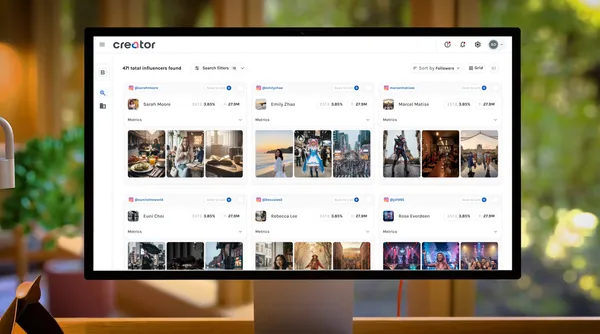
The Creator.co platform makes it easy to discover and evaluate influencers at scale, displaying key metrics like engagement rates and follower counts alongside content samples.
Seeding product ahead of the sale so content is ready to convert
Product seeding is the tactic that separates brands with a real holiday marketing strategy from those with a last-minute campaign. You send product to creators weeks before your sale. They use it, form genuine opinions, and post content that has already built reach and trust by the time your discount goes live.
The seeding package matters. Include the product, a brief card explaining the Holiday offer without over-scripting the creative, and any context the creator needs to tell the story, such as ingredients, origin, or use occasions. Do not write a script. Give creators the facts and the offer, then let them find their angle.
Timing the reveal is equally important. Seed 6 weeks out so creators can post teaser content 4 weeks out, building audience familiarity before the offer lands. The audience has already seen the product in context. The sale then becomes the trigger to act, not the first time they encounter the brand.
Meyenberg's holiday campaign on Creator.co shows what this looks like when it works. Seasonal culinary creators seeded with Meyenberg's goat milk products produced content that generated 142,000 views and $15,200 in earned media value (EMV). EMV measures the equivalent cost of that reach if purchased through paid media. Saves signal genuine purchase intent: someone bookmarked the content to return to it. Those numbers came from authentic seasonal storytelling, not scripted ads.
This approach is the core of product seeding and influencer gifting as a strategy. That hub covers the full gifting mechanics in depth. (Link will be live once the hub publishes.)
Structuring the campaign for conversion, not just reach
Organic creator posts build trust. Paid amplification turns that trust into measurable sales. The two work together during Holiday Season, but they need to run in sequence, not in parallel from day one.
Content structure across the campaign funnel should follow this pattern:
Campaign phase | Content type | Goal |
|---|---|---|
4–2 weeks out | Teaser and product-in-use posts | Audience awareness, algorithm traction |
Sale week | Direct offer posts with creator codes | Conversion, attribution |
Cyber Monday | Best-performing content extended via paid | Retargeting, late converters |
Whitelisting, lets you run paid ads from a creator's account rather than your brand account. This keeps the authentic creator format while giving you full paid targeting control. You pick the content that performed best organically, then boost creator content in paid media during sale week when purchase intent peaks.
Every creator in your campaign should have a unique discount code and an affiliate tracking link. This gives shoppers a clear incentive to buy through that creator's content. It also gives you clean attribution data to measure which creators drove actual revenue, not just impressions.
COSMO's back-to-school campaign on Creator.co shows what boosting creator content during a seasonal window can produce: 8.2x ROAS, with $100,600 in sales from $12,000 in ad spend. That campaign ran creator content in paid media rather than traditional brand creative. The creative looked native to the platform because it was. The result was a seasonal ROAS that most paid social campaigns do not come close to.
Measuring your Black Friday creator campaign
Most measurement conflates the general seasonal lift with what creators actually drove. Separate the two. Your creator campaign has its own attribution layer through creator codes and affiliate links. Start there.
The metrics that matter for a creator-led Black Friday campaign:
Metric | What it tells you |
|---|---|
Revenue attributed to creator codes | Direct creator-driven sales |
ROAS on boosted creator content | Paid efficiency of best content |
Engagement rate per creator | Audience quality and content resonance |
EMV (earned media value) | Organic reach equivalent in paid cost |
Retail sell-through by location | In-store lift from local creator activity |
EMV and engagement rate tell you which creators built genuine audience interest. Creator codes and ROAS tell you which creators converted that interest into purchases. Both sets of data matter, because strong engagement with weak conversion often points to a misaligned offer or the wrong audience, not a bad creator.
COSMO's 8.2x ROAS is a useful internal benchmark. It does not mean every campaign hits that number. It means the combination of seasonal timing, creator authenticity, and paid amplification can produce significantly better returns than traditional paid creative. Creator.co's data across 10,000-plus brand campaigns shows seasonal campaigns consistently outperform evergreen campaigns when the creative is built from real seeded content.
Capture creator-level performance data in a structured way after the campaign. Which creators produced the most saves and shares? Which content formats drove the most attributed sales? Which offer type converted at the highest rate? That data becomes next year's sourcing shortlist and brief. Brands that measure influencer marketing results with this level of detail build a compounding advantage. Each BFCM campaign outperforms the last because the brand already knows what works.
Turn this Black Friday into next year's playbook
The brands that consistently win the Holiday Season do not reinvent the campaign each year. They treat it as a repeatable seasonal system. The creators they seed this October become the relationship they activate again next September. The content formats that converted this year become next year's brief. The offer structure that drove the best ROAS becomes the default.
That system starts with seeding. The product seeding and influencer gifting hub covers the foundational mechanics in full. Black Friday is the highest-stakes moment to apply those mechanics, but the same approach runs across every seasonal window your brand owns. (Link will be live once the hub publishes.)
The window to start is now. Brands building their creator shortlist in early October are eight weeks ahead of the brands that start in November. That gap compounds fast.
Ready to run your first creator campaign?
Search 270K+ creators, manage briefs, and handle payments — all in one platform. Used by Nike, Fender, and 10,000+ brands.